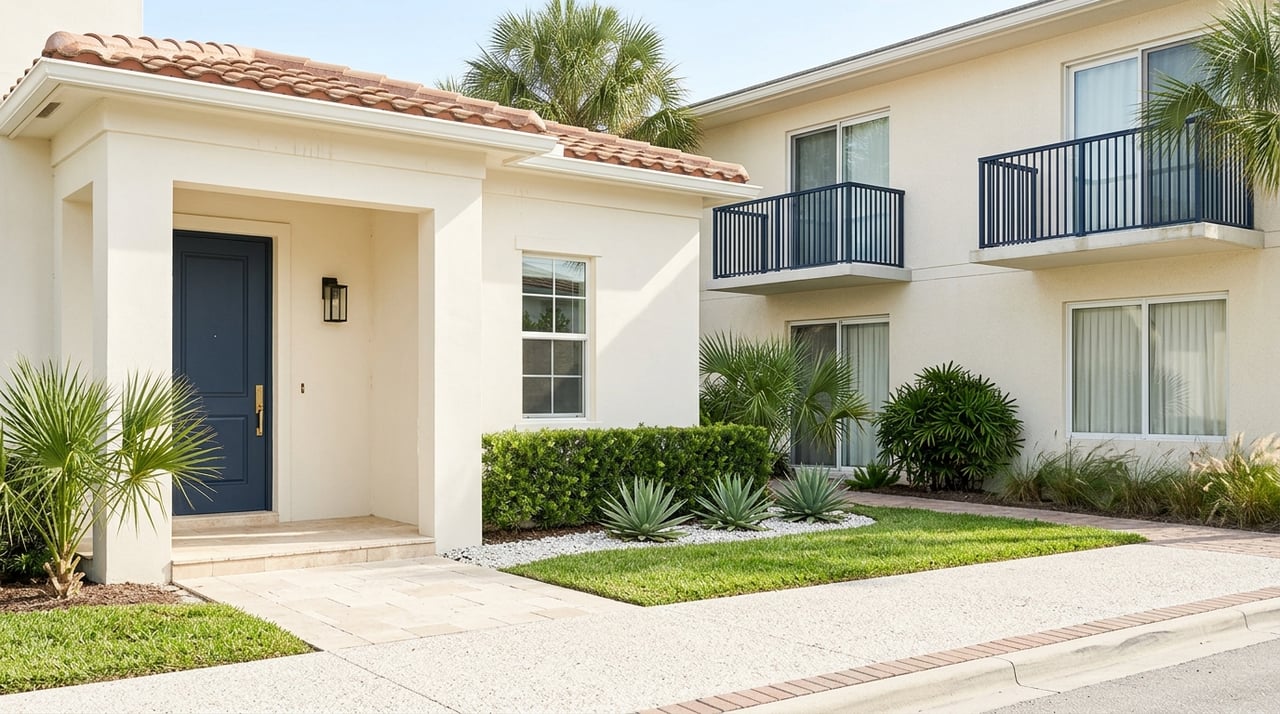
Wondering whether a Watersound condo or a single-family home is the better fit for your coastal lifestyle? It is a smart question, especially because Watersound is not one uniform neighborhood with one simple answer. Your best choice depends on how you want to live, what level of maintenance you want, and how the specific community handles fees, amenities, and rental rules. Let’s break it down.
Watersound Is Not One-Size-Fits-All
One of the most important things to know is that Watersound is a collection of subcommunities across Bay and Walton counties, not one single HOA with one set of rules. The residential mix includes single-family homes, apartments, townhomes, independent living, and age-restricted communities. That means your condo-versus-house decision is really a neighborhood-specific decision.
In practice, two properties with the Watersound name can offer very different ownership experiences. One community may focus on long-term residential living, while another may feel more like a coastal resort setting with layered amenities and stricter operational rules. That is why reviewing the specific governing documents matters just as much as touring the property itself.
Condo vs. House Costs
Many buyers assume condos always have higher fees and single-family homes always cost less to own month to month. In Watersound, that is not always true. Fees are often shaped by the association structure, reserve planning, and amenity package more than by property type alone.
A current Watersound Beach condo example on Compass Point Way shows HOA fees of $8,583 per quarter. Those dues reportedly include accounting, ground keeping, internet service, master association, recreational facilities, security, sewer, and trash. That kind of bundled cost can simplify ownership, but it can also come as a surprise if you are only comparing purchase prices.
Single-family homes can carry much lower dues in some Watersound neighborhoods, but there is still a wide range. Current Watersound Origins examples show HOA dues of $127 per month and $195 per month, while one Watersound Beach single-family listing shows $1,665 per quarter. In other words, a detached home is not automatically the low-fee option.
Why Condo Fees Can Be Higher
Florida condo law places common element maintenance on the association. Condo budgets must also include reserve accounts for capital expenditures and deferred maintenance. For residential condos that are three habitable stories or higher, Florida requires a structural integrity reserve study at least every 10 years, with reserve funding tied to that study.
For you as a buyer, that means condo ownership can be more fee-heavy and more sensitive to reserve planning and special assessments than expected. The benefit is that major building-level responsibilities are shared through the association. The tradeoff is that you have less direct control over those costs.
Why House Fees Still Matter
Single-family ownership often feels more independent, but HOA costs and reserve policies still matter. Under Florida HOA law, budgets may include reserve accounts, but reserve funding can vary based on governing documents and member votes. If reserves are not fully funded, special assessments can still become a risk.
That is why the smarter question is not just “What are the dues?” It is “What do the dues cover, how are reserves handled, and are any amenity or membership fees included?”
Maintenance and Convenience
If your goal is low-maintenance, lock-and-leave living, a condo may be appealing. Condos usually shift more exterior and building-related responsibilities to the association. That can be especially attractive if you plan to use the property seasonally or want a simpler ownership experience.
A Watersound Beach condo example shows a building with 25 residences, which highlights the shared nature of condo living. Because owners share buildings and common systems, associations also tend to have more control over exterior decisions and building operations. That can mean less day-to-day maintenance for you, but also less individual flexibility.
Single-family homes typically offer more control over your space and outdoor areas. You may have a more traditional neighborhood feel and a little more breathing room. Still, Watersound communities are not rule-free, so detached ownership does not mean complete freedom to use the property any way you want.
Privacy and Lifestyle
For many buyers, the biggest difference comes down to how you want daily life to feel. Condos usually offer convenience and shared amenities, but they also tend to come with denser living and more building-level rules. If you value ease over privacy, that can be a very good trade.
Single-family homes usually offer more privacy, more separation from neighbors, and greater outdoor control. In a coastal market like Watersound, that can be a major advantage if you want a quieter feel or simply enjoy having more personal space. It can also be appealing if you picture yourself spending more time outdoors at home.
Watersound West Beach is a good example of how detached-home living can still come with structured community expectations. The neighborhood is low-density and walkable, with private boardwalks and a zero-entry pool, but published renter rules also address parking, trash, beach behavior, golf carts, guests, and noise. Violations can result in a $100 fine assessed to the owner.
Amenities Can Blur the Line
In Watersound, amenities can make the condo-versus-house choice less clear-cut. Some buyers assume condos come with the resort lifestyle while houses do not, but that is not always the case. Depending on the community, both property types may connect to strong amenity offerings.
Watersound Club properties add access to private beach, golf, pools, dining, and other member amenities. The Beach Club includes private beach access, two zero-entry pools, chair and umbrella setups, tennis, and dining. Watersound Origins also offers a resort-style pool, trails, golf, fitness, tennis, pickleball, and dock access through Watersound Membership.
In Watersound Origins, access to Village Commons and the Lake Powell Dock is tied to Watersound Membership, and the related fees are currently included as an amenity fee in HOA dues. That is a great reminder that lifestyle value is often built into the fee structure. Before you compare property types, compare what each one actually gives you.
Rental Rules Matter More Than Property Type
If you are buying with rental income in mind, do not assume a condo is automatically the better investment or that a house offers fewer restrictions. In Watersound, rental rights vary sharply by subcommunity. Your intended use needs to line up with both the neighborhood documents and Walton County rules.
Walton County requires annual registration for short-term vacation rentals. The county also recommends completing the certification process if a property will be rented for extended periods such as three months or more each year. Local rules also require a responsible party and set expectations for lease content, noise, parking, trash, and signage.
Community rules can narrow your options even further. Watersound Origins states that the community has no short-term rentals. Watersound West Beach publishes detailed renter rules and fines, showing that rental use can be carefully managed even in detached-home neighborhoods.
Best Questions for Rental Buyers
Before you move forward on any Watersound property, ask:
- Is this property governed by a condo association, an HOA, or both?
- Are short-term rentals allowed in this specific subcommunity?
- What county registration requirements apply in Walton County?
- What rules apply to guests, parking, trash, noise, and golf carts?
- Are there additional club or amenity fees that affect your rental math?
For investor-minded buyers, the real issue is not condo versus house in the abstract. It is whether the exact property supports your rental plan.
Which Option Fits You Best?
If you want a more turnkey experience, a condo may be the better fit. You may appreciate bundled services, shared maintenance, and a simpler lock-and-leave setup. That can be especially appealing for second-home buyers who want less hands-on responsibility.
If you want more privacy, more outdoor control, and a more traditional residential feel, a single-family home may be the stronger choice. That can work well for lifestyle-driven buyers or anyone planning longer stays. Just remember that HOA rules, amenity fees, and rental limits can still shape the ownership experience.
In Watersound, the strongest buying decisions usually come from matching your goals to the right subcommunity. Watersound Origins tends to lean toward long-term residential ownership. Watersound West Beach leans toward low-density coastal living with clear neighborhood rules. Watersound Beach condo buildings often place more shared services into association dues.
A thoughtful side-by-side review of fees, reserves, rules, amenities, and rental rights can save you from expensive surprises later. That is where local guidance matters. If you want help sorting through Watersound options and narrowing in on the right fit for your lifestyle or investment goals, connect with Stephanie Phillips.
FAQs
Should you expect all Watersound communities to have the same HOA rules?
- No. Watersound is a collection of subcommunities, so rules, fees, rental policies, and amenities can vary significantly by neighborhood.
Are condo fees in Watersound always higher than single-family home dues?
- Not always. Condos often have higher dues because they bundle more services and reserve obligations, but some single-family homes in Watersound also carry substantial quarterly or monthly fees.
Can you use a Watersound single-family home as a short-term rental?
- It depends on the specific subcommunity and Walton County requirements. Some Watersound neighborhoods restrict or prohibit short-term rentals.
What should you review before buying a Watersound condo?
- Review what the dues cover, how reserves are funded, whether there is any risk of special assessments, what amenities are included, and what rules apply to the building and property use.
What should you review before buying a Watersound house?
- Review the HOA structure, dues, reserve funding, amenity access, rental restrictions, and operational rules for things like parking, guests, trash, and golf carts.